
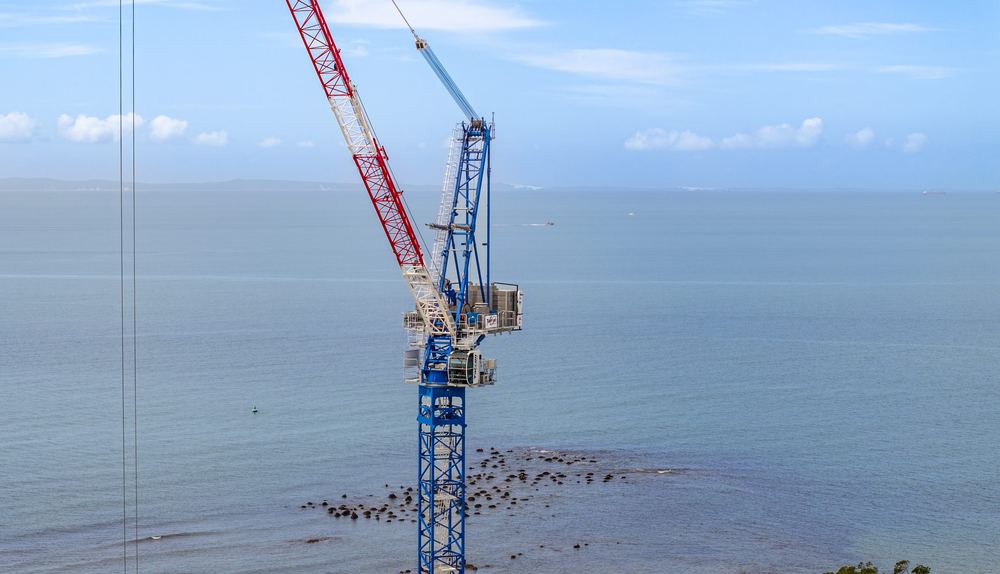
Flat-top
The jib stays horizontal and there is no structure above it. Flat-tops are quicker and cheaper to erect, need fewer crane movements to assemble, and are the default where the site has clear airspace and nothing close by to swing around. See our flat-top cranes.
Luffing jib
The jib pivots up and down from the mast head. When it is not working it parks steep, close to vertical, so its working circle is much smaller than a flat-top of the same reach. That is what lets a luffing crane work a tight city block: between other cranes, alongside an existing building, or where a flat-top's counter-jib would swing over a neighbour or a road. Luffing cranes cost more and take longer to erect. We sell two kinds of luffing crane: hydraulic luffing, where a ram moves the jib, for compact cranes; and rope luffing, where a winch and wire rope move it, for the heaviest lifts.
Hammerhead
The older flat-jib design, with an A-frame peak above the cab that carries the support cables. It does the same work as a flat-top; the flat-top design simply drops the peak. You will still see hammerheads on sites and they are a sound choice where the site suits a horizontal jib. We don't sell them.
How to choose
- Over-sail: if the jib or counter-jib would pass over a property you don't control, a luffing crane can often avoid it, or shorten the agreement you need.
- Adjacent cranes: two flat-tops on neighbouring sites have to be set at different heights to clear each other. Luffing cranes can work closer.
- Flight paths: near an airport there are height limits and a luffing jib that parks low is easier to approve.
- Cost and programme: where none of the above applies, a flat-top is the cheaper, faster option.
Tell us the site constraints with your enquiry and we will say which type fits and which of our cranes suit it.
Common questions
Is a luffing crane always better for a tight site?
For airspace and over-sail, usually. But it costs more and takes longer to put up and take down, so on an open site a flat-top is the better value.
Can you convert a flat-top to a luffing jib?
No. They are different cranes. The choice is made when the crane is selected.
Have the job in front of you? Tell us the load, the radius and the site →